
Creating a breakthrough for Vietnamese agricultural specialties: 'Decisive turning point' from deep processing innovation
- 23 thg 7, 2025
- 5 phút đọc
Đã cập nhật: 24 thg 7, 2025
To create a breakthrough for Vietnamese agricultural specialties that are at a “decisive crossroads” by innovating and creating deep processing instead of being “stuck” with monotonous raw products, it is important that businesses demonstrate their desire to improve, “dare to do things differently, and do them with all their heart”, invest systematically, and know how to wisely take advantage of natural advantages.

Recently, when participating in the fair of buyers in Korea with other Vietnamese enterprises in the food industry, Tan Nhien Company Limited made a strong impression on consumers in this country's market with deeply processed local specialties, notably rice paper products that are not soaked in water.
Desire to improve
Tan Nhien Company representative said that the rice paper product without dipping in water has touched the curiosity and love of Korean customers. Many Korean consumers are surprised to feel that this product is thin, flexible, soft, just need to roll and eat immediately, no need to dip in water or wait, very convenient, creative and full of Vietnamese flavor.
Notably, in 2025, the company's non-wet rice paper products were recognized as 5-star OCOP at the national level, demonstrating its different and sustainable direction. Along with that, the company regularly makes its mark at international fairs such as Thaifex (Thailand), Korea Import Fair (Korea), China - ASEAN Fair, and officially exports to many demanding markets such as the US, Japan, Taiwan, Korea, etc.
It can be seen that this is also a “sweet fruit” by innovating and creating deep processing for local agricultural raw materials such as cassava (cassava root) in the place where this company has its factory, Tay Ninh province. To do that, Mr. Dang Khanh Duy, General Director of Tan Nhien Company, emphasized that it is important to have the aspiration to elevate Vietnamese specialties.
As Mr. Duy shared, if you want to preserve the soul of the countryside, you cannot just stop at tradition. You have to combine identity and innovation, culture and technology, quality and modern experience. And for international consumers, you need to make them not only impressed by the convenience and safety of the product but also conquered by the story of a Vietnamese brand that "dares to do things differently, and does it with heart".
From the story of the above product, according to experts, the creative economy is entering a period of strong transformation in Vietnam and businesses in the agricultural specialty industry cannot stand on the sidelines of this trend, and must give more priority to innovation in deep processing.
For example, in the fruit and vegetable industry, one of the solutions to take advantage of local fruit and vegetable resources to increase competitive advantage is that domestic enterprises need to invest in deep processing technology and diversify products.
Take bananas, for example. By mid-2025, Vietnam will have more than 161,000 hectares of bananas, with an average yield of 207 quintals/ha. In 2024, bananas will bring in 380 million USD, accounting for 2.5% of the global banana market share. Vietnam currently ranks 9th in the world in banana exports and is among the countries with the highest growth rates.
However, most Vietnamese bananas are currently exported fresh, mainly to China, Korea, Japan, etc. Meanwhile, processed products such as dried bananas, banana powder, banana juice, etc. are still developing on a small scale.
As the owner of a business in the Mekong Delta with a long history of exporting bananas, Mr. Vo Quan Huy believes that to improve the banana industry, Vietnam needs to invest in a systematic processing chain and strongly shift to exploiting the values from by-products (stems, leaves, flowers, tubers, etc.).
“This is a way to escape dependence on the fresh banana market and increase added value for the banana industry,” Mr. Huy emphasized.
Or like pineapple. The country currently has more than 52,500 hectares of pineapple, with an expected output of more than 800,000 tons by 2026. Vietnamese pineapple has been exported to many demanding markets such as the EU, the US, Japan... with the main products being fresh pineapple, canned pineapple and juice.
However, in order for Vietnam's pineapple industry to compete sustainably, experts point out that it is necessary to promote investment in deep processing technology and diversify products such as pineapple jam, dried pineapple, fermented pineapple, etc.
Make wise use of natural advantages
From a management perspective, Mr. Tran Thanh Nam, Deputy Minister of Agriculture and Environment, emphasized that Vietnam has enough potential to turn fruits into a key export product, if it knows how to take advantage of natural advantages, especially promoting deep processing, building value chains and developing systematic brands.
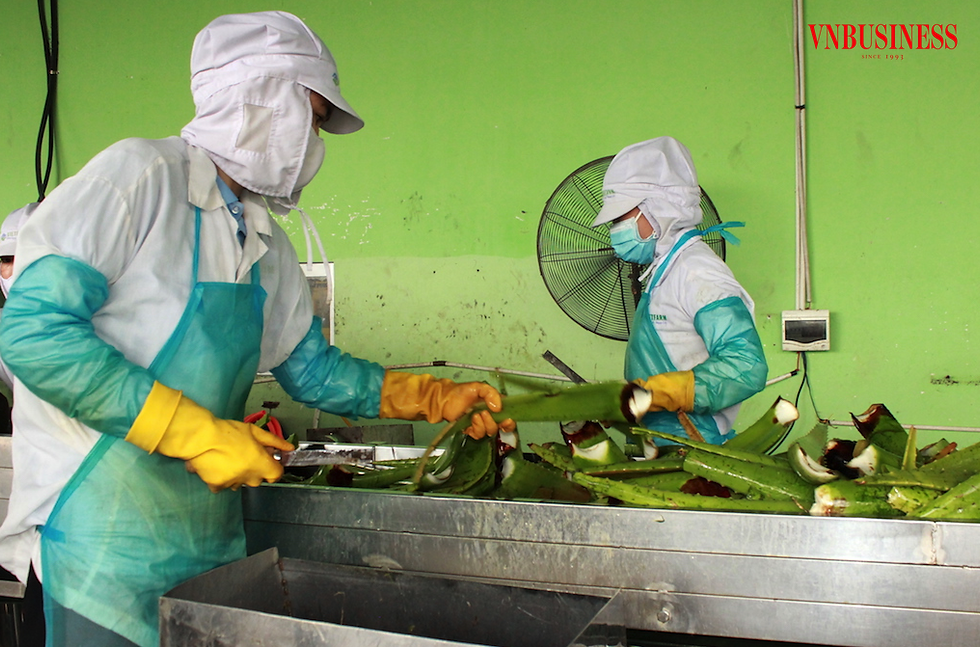
Not only that, even by-products from local agricultural specialties need to be creatively utilized and exploited by businesses through deep processing. The latest case is the start-up group S2M – Sustainable to Mekong, which has used bio-recycling technology to turn mango peels and dragon fruit peels into high-end bio-leather – considered the “green diamond” of the sustainable fashion industry thanks to its unique texture (the “soul” of the fabric surface), water resistance and natural antibacterial properties.
Such recycling is very meaningful when Vietnam throws away more than 2 million tons of fruit peels every year, of which mango peels and dragon fruit peels account for 40%. And turning fruit peels (such as mango peels and dragon fruit peels) into high-end bio-leather is clearly a very bold and creative direction, meeting the right needs in the sustainable fashion market.
As shared by Ms. Nguyen Thi Thanh Van – founder of S2M, this is an opportunity for the public to witness the journey of “waste into gold”, from the laboratory to the global market.
“We don’t just want to change the leather industry, we want to change how the world perceives waste,” said Ms. Van.
And regarding the issue of deep processing innovation for Vietnamese agricultural specialties, according to Mr. Dang Khanh Duy, the important thing is to build a decent specialty ecosystem. For example, from undipped rice paper, the company continues to expand the product ecosystem: shrimp salt, mixed rice paper, dipping sauce, Tay Ninh specialty spices... Each product is developed with the same spirit of creativity, difference, kindness and sustainability.
Along with that, Mr. Duy also pointed out three pillars: traceability, automation, skilled team. This is not only a technical factor, but also a foundation for businesses to strictly control quality and continuously improve.
Regarding the difference, this general director said that “being different is not to stand out – but to create real value”.
Overall, to create a breakthrough for Vietnamese agricultural specialties, it is waiting for a “decisive turn” from businesses by innovating in deep processing. They should have a long-term vision, invest heavily in technology and wisely utilize local agricultural resources instead of being “stuck” with raw products that are both monotonously processed, have low value and are less competitive.
(Source: vnbusiness)


Bình luận